PADI Deep Diver Course in Punta Cana
Explore deeper dive sites safely with the PADI Deep Diver course
Go Deeper and Expand Your Dive Limits
The Deep Diver course is designed for adventurous divers who want to explore beyond the standard recreational depths. With this certification, you'll be able to safely dive to depths of up to 40 meters (130 feet), opening up access to deep wrecks, dramatic walls, and breathtaking reefs that few get to experience.
Punta Cana gives that certification a purpose. Shark Point sits at 24 to 30 meters, and near Bayahibe the St. George — a 73-meter cargo ship — waits at 40 meters, right at your new limit. This is a course with a payoff you can dive the same week.
You'll need an Advanced Open Water certification (or equivalent) to enroll. The course includes four training dives, all equipment, and the option to complete your theory through PADI eLearning before you arrive.
- ✓All equipment provided
- ✓Hotel transport included
- ✓Small groups, personal attention
Reserve Now · Contact Us
Why Deep Diving Is Different
Diving at greater depths requires more than just curiosity — it demands knowledge and skill. You'll learn how to plan deep dives, manage your air supply effectively, and understand how depth affects your body and equipment. This course ensures you can explore safely while enjoying the thrill of deep-water adventures.
At depth, your air goes faster, your margins get thinner, and small mistakes grow. That's why this course centers on gas planning: knowing how much you need, how much to hold in reserve, and how to stay comfortably inside your no-decompression limits from descent to safety stop.
Conditions here work in your favor. With water at 26–29°C (78–84°F) year-round and visibility typically between 15 and 25 meters, you can concentrate on procedure instead of fighting the cold.

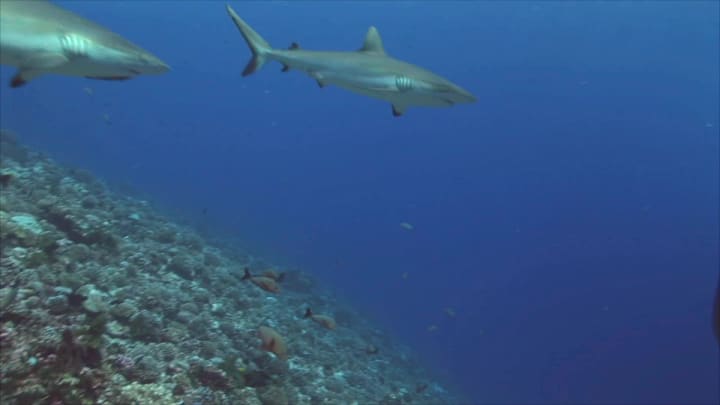
A glimpse of what you'll see
Understanding the Risks and How to Manage Them
Deep diving introduces challenges such as nitrogen narcosis, increased air consumption, and changes in buoyancy control. You'll learn how to recognize and manage these factors, as well as how to minimize risks through careful preparation and proper use of dive computers and tables.
Gas narcosis deserves special attention. Many divers feel its effects at depth: slowed thinking, tunnel focus, a false sense of ease. You'll learn to recognize the signs in yourself and in your buddy — and the straightforward fix, which is to ascend a few meters and let it clear.
There's no shortcut to that kind of judgment except practice under supervision, and that's exactly what your training dives provide.
Building Your Deep Diving Knowledge
In the classroom portion, you'll gain an in-depth understanding of the physics and physiology of deep diving. Topics include gas absorption, oxygen toxicity, the importance of extended safety stops, and dive planning strategies that keep you safe and within no-decompression limits.
If you prefer, complete this theory at home through PADI eLearning before your trip. That way your time in Punta Cana is spent underwater rather than in a classroom, and you arrive with your dive planning fundamentals already in place.
Practical Deep Diving Experience
The course includes four open water dives where you'll apply your skills at greater depths. Under the supervision of an experienced instructor, you'll practice descent and ascent procedures, buoyancy control, navigation, and air management while exploring stunning underwater landscapes.
Shark Point, sitting at 24 to 30 meters, is a natural training ground for your progression dives — deep enough to feel the difference, generous enough in visibility to stay oriented. Each dive goes a little deeper as your comfort grows.
Our instructors teach in English, Spanish, and French. All equipment is included, so the only things you need to bring are an Advanced Open Water card and a taste for depth.
Your Deep Diver Certification
After completing the course, you'll be certified to dive to 40 meters (130 feet), giving you the freedom to explore deeper sites worldwide. With this new skill set, you'll unlock opportunities to experience marine life, wrecks, and geological features that are only found in the deeper zones of the ocean.
Locally, that means one dive above all: the St. George. This 73-meter Scottish-built cargo ship rests at 40 meters near Bayahibe and features on our Bayahibe day trips. Descending along her hull with your new certification is the kind of dive that stays with you.
The Deep Diver Specialty costs $400 for four dives with everything included. Go deeper — it's worth it.
Ready to get started?
Reserve your spot with a 50% deposit. We'll confirm your dates and send everything you need to prepare.
Frequently asked questions
What is the PADI Deep Diver course?
The PADI Deep Diver course teaches certified divers how to plan and safely conduct dives beyond 40 meters (130 feet), including deep dive procedures, gas management, and safety considerations.
How many dives are included in the Deep Diver course?
The Deep Diver course includes 4 dives.
What are the prerequisites for the Deep Diver course?
To enroll, you must be certified as a PADI Advanced Open Water Diver or hold an equivalent certification from another recognized training organization.
What is the minimum age for the Deep Diver course?
The minimum age for the Deep Diver course is 15 years old.
How much does the Deep Diver course cost in Punta Cana?
The Deep Diver course in Punta Cana costs $400 USD.
Do I need previous deep diving experience to take this course?
No previous deep diving specialty certification is required. The course is designed to help qualified divers build deep diving skills progressively under instructor supervision.
What will I learn in the Deep Diver course?
You will learn about deep dive planning, gas supply management, buddy contact procedures, safety stops, and how depth affects your dive and equipment.